
13,000-Year-Old Native American Campsite Under Farm Details Hunters’ Way Of Life
13,000-Year-Old Native American Campsite Under Farm Details Hunters’ Way Of Life
Archaeologists in Michigan have discovered a 13,000-year-old camp site of the mysterious Clovis people, which they believe may be the earliest evidence of humans in the region.
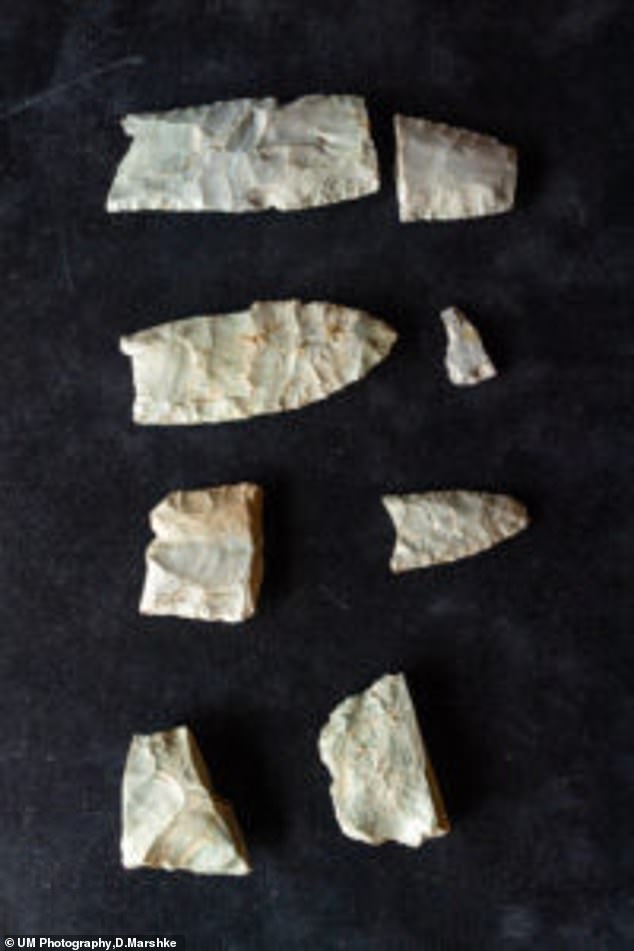
A group of researchers, led by those from the University of Michigan, have found more than 20 Clovis tools over the years, starting in 2008.
Clovis tools are made from a high-quality stone known as chert and are made a specific way, with a central channel going through the middle of it.
It’s believed that the site, located in St. Joseph County, was occupied by a small group of people — roughly six or seven — who lived on a river in what is now the southwestern part of the state at the end of the Pleistocene era.
The site is relatively small, at roughly 82ft (25m) by 50ft (15m), ‘similar in size to other Paleoindian camping sites,’ according to a statement from the University of Michigan.
YOU MAY ALSO LIKE: This 2,700-Year-Old Chinese Face Cream Combined Animal Fat and ‘Moonmilk’
The experts also uncovered ‘hundreds of pieces of manufacturing and refurbishment debris’ as well as flakes of material that show the inhabitants of the camp were making tools at the site, according to the statement.
‘At present it is the northwestern-most such occurrence in the Great Lakes region,’ researchers wrote in the study.
The Clovis culture is said to be the first widespread prehistoric culture in the Americas after arriving roughly 13,000 years ago.

There was little evidence of human inhabitance prior to the discovery of the tools - the first one coming in 2008 - as most of Michigan was ‘uninhabitable’ during the time period, covered by glaciers, save for a small triangular swath in the southwestern part of the state.
‘As the glaciers were retreating, they created a predictable ice-front environment that was frequented by early humans’ favorite prey,’ the study’s lead author, Brendan Nash said in the statement.
‘Early humans had a wolf model of subsistence: They travelled around in large groups and didn’t stay in any place too long. They were an apex predator and probably doing both hunting and scavenging, perhaps by running other ice age predators such as saber-toothed tigers and short-faced bears off their prey.’
Nash continued: ‘What we have at the Belson site appears to be a short-term camp by a group that would likely split off from the main group seasonally.’
One of the researchers, Thomas Talbot, found the first Clovid spear point in 2008 at a farm and said these are unmistakably part of a larger discovery and most definitely from the Clovis people.
‘Paleolithic pieces—not quite this old, but pieces that are similar—have turned up around Michigan, but usually they are pretty scattered, like maybe someone lost it while they were hunting or walking through,’ Talbot said.
‘So although I thought it was really cool, I thought it was a once-in-a-lifetime finding. But other pieces started turning up, and by the end of the spring, it was pretty clear that I had Clovis components at this site.’
It’s unclear what caused the disappearance of the Clovis people, but some researchers believe that an asteroid or comet wiped them out.
Tools made by the Clovis, such as projectile points or hide scrapers, had a central channel going through the middle of it, known as a flute.
They are also made from chert, also known as Attica chert or Indiana greenstone.
This material, greenish blue gray or gray in colour, is commonly found in western Indiana or eastern Illinois, according to the Smithsonian.
Chert is also often infused with halcedonic quartz and often has ‘a coarse to very smooth, fine-grained, or glossy texture.’
The site is now known as the Belson Site, after the family that owns the land and adds to Michigan’s heritage as a place for further archaeological discovery, Nash said.
‘Michigan culture history has always been thought to be piecemeal of other place’s culture histories that happen to be coming into and out of Michigan periodically.
‘Now what we’re seeing is that we’ve got a presence that is as early as other sites in North America, and it has the same technology.’
YOU MAY ALSO LIKE: Face of 50,000-year-old ‘Krijn’ reconstructed from Neanderthal skulls
The research was published earlier this year in the scientific journal PaleoAmerica.
In 2018, researchers discovered 150,000 ‘unique’ tools northwest of Austin Texas, made by the Clovis people.




Rare Ancient DNA Provides Window Into a 5,000-Year-Old South Asian Civilization

Damascus blacksmiths used carbon nanotubes to make steel swords long before they were scientifically discovered

Russia Looking To Clone And Resurrect 3,000-Year-Old Ancient Siberian Warriors
About Author
