
Mass grave of Viking army contained slaughtered children to help dead reach afterlife, experts believe
Mass grave of Viking army contained slaughtered children to help dead reach afterlife, experts believe
A mass grave uncovered in Derbyshire is believed to be the burial site of a Viking Great Army.
Archaeologists have also discovered four sacrificial remains to accompany the warriors into the afterlife.
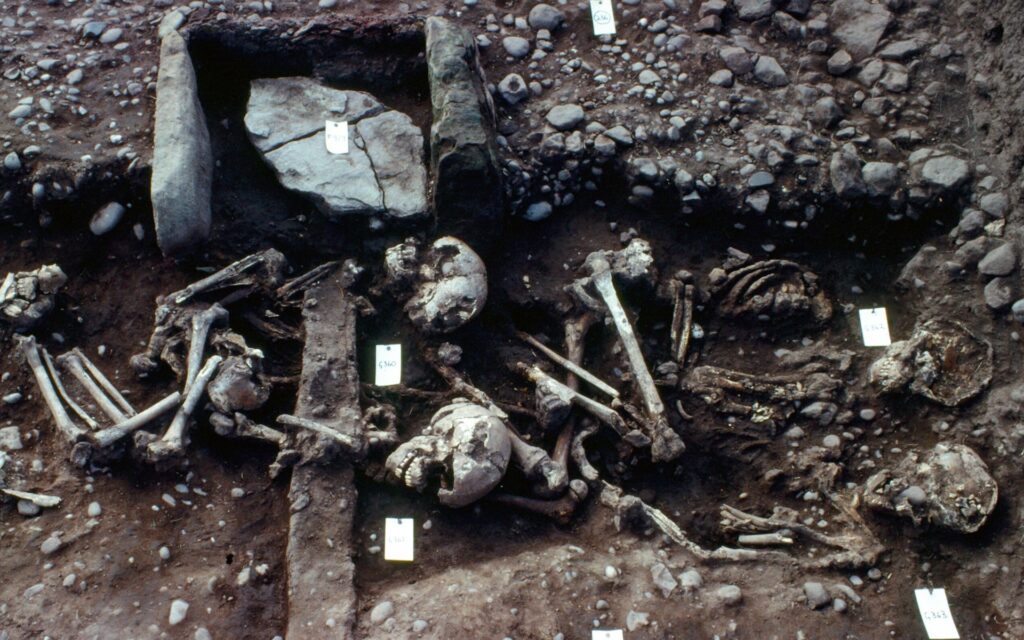
The mass grave was initially uncovered in Repton in the 1980s, with radiocarbon dating suggesting the grave held bones collected over several centuries including monks and nuns.
However, new dating puts them all in the ninth century, meaning they could be the remains of the Viking force that drove out the king of Mercia.
Repton was a significant royal and ecclesiastical centre in the Anglo-Saxon kingdom Mercia but became a Viking stronghold for the army, known to the Anglo Saxons as the Great Heathen Army, after they seized it
YOU MAY ALSO LIKE: 3,000-year-old ‘lost golden city’ of ancient Egypt discovered
It was the location of a double monastery for men and women ruled by an abbess, established in the third quarter of the seventh century which would then have been on the banks of the River Trent.
Historical records state the Viking Great Army wintered in Repton in 873 A.D. and drove the Mercian king into exile to Paris.
Now new research by the University of Bristol’s Department of Anthropology and Archaeology found the bones are all consistent with a date in the late 9th century.
This undermines the previous theory some of the skeletal remains in the charnel originated from the monastic cemeteries.
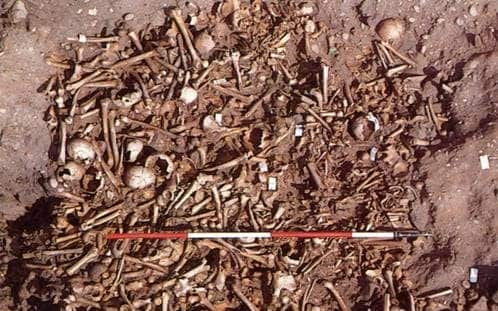
Excavations led by archaeologists Martin Biddle and Birthe Kjølbye-Biddle at St Wystan’s Church in Repton in the 1970s and 1980s discovered several Viking graves and a charnel deposit of nearly 300 people underneath a D shaped shallow mound in the vicarage garden.
The mound appeared to have been a burial monument linked to the Great Army.
An Anglo-Saxon building, possibly a royal mausoleum, was cut down and partially ruined, before being turned into a burial chamber.
One room was packed with the commingled remains of at least 264 people, around a fifth of whom were women.
Among the bones were Viking weapons and artefacts, including an axe, several knives, and five silver pennies dating to the period 872 to 875 A.D.
Four-fifths of the remains were men, mostly aged 18 to 45, with several showing signs of violent injury.
During the excavations, extensive evidence of a large defensive ditch was also found and everything pointed to the burial’s association with the Viking Great Army.
But confusingly, initial radiocarbon dates suggested it seemed to contain a mix of bones of different ages, meaning they could not all have been from the Viking Age.
The new dating proves they are all consistent with a single date in the 9th century and therefore with the Viking Great Army.
Bioarchaeologist, Dr Cat Jarman explained: ‘The previous radiocarbon dates from this site were all affected by something called marine reservoir effects, which is what made them seem too old.
‘When we eat fish or other marine foods, we incorporate carbon into our bones that is much older than in terrestrial foods.
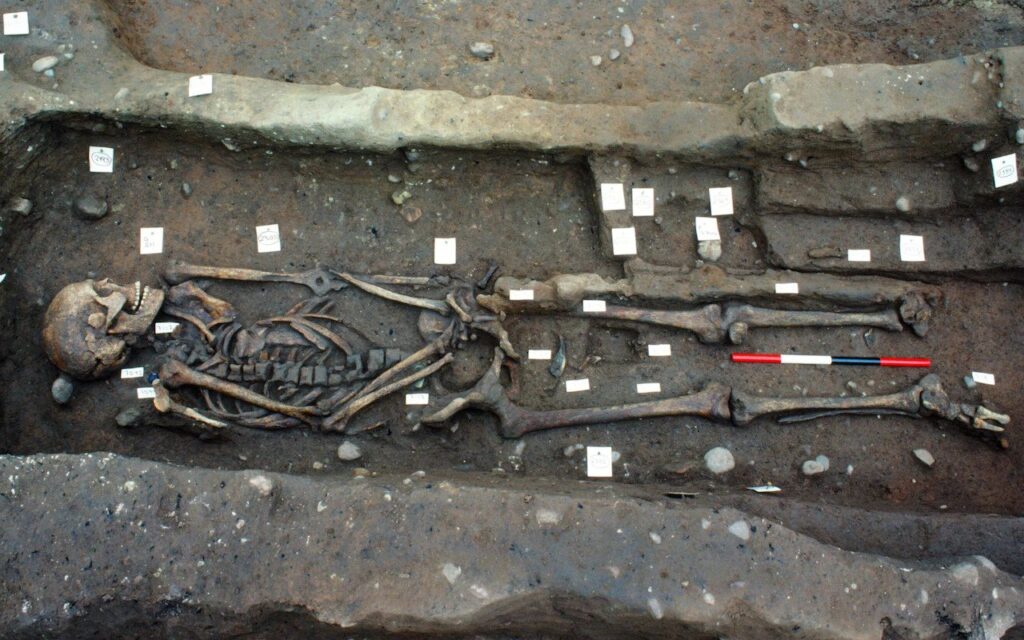
‘This confuses radiocarbon dates from archaeological bone material and we need to correct for it by estimating how much seafood each individual ate.’
A double grave containing two men, the older of whom was buried with a Thor’s hammer pendant, a Viking sword, and several other artefacts.
YOU MAY ALSO LIKE: Archaeologists have discovered an Egyptian mummy buried with a golden tongue
He had received numerous fatal injuries around the time of death, including a large cut to his left femur.
Intriguingly, a boar’s tusk had been placed between his legs, and it has been suggested that the injury may have severed his penis or testicles, and that the tusk was there to replace what he had lost in preparation for the after-world.
3 Feb 2018
Study Confirms Ancient Spanish Cave Art Was Made By Neanderthals
The Babylonian captivity or Babylonian exile
Metal artifacts in Southeast Asia challenge long-held archaeological theory
About Author
