
Iron Age skeleton of a human, dogs and a sex object found near Aarhus in Denmark
Iron Age skeleton of a human, dogs and a sex object found near Aarhus in Denmark
A gruesome find in a Danish bog has given archaeologists a glimpse into the mysterious and macabre practices of an Iron Age community.

Experts have found a decapitated human skeleton alongside the remains of dogs that were believed to have been sacrificed as an offering to the gods around 2,000 years ago.
The discovery was made on the same site where a wooden phallus was previously recovered in Skødstrup, north of the city of Aarhus in central Denmark.
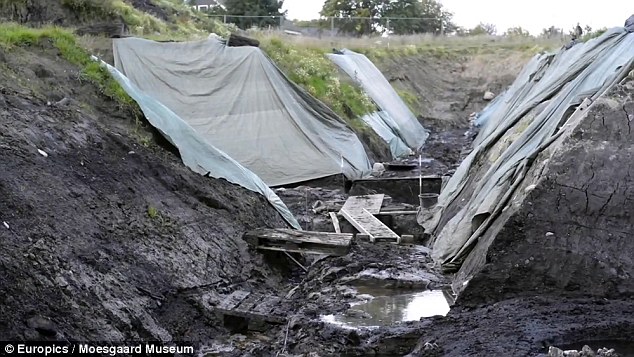
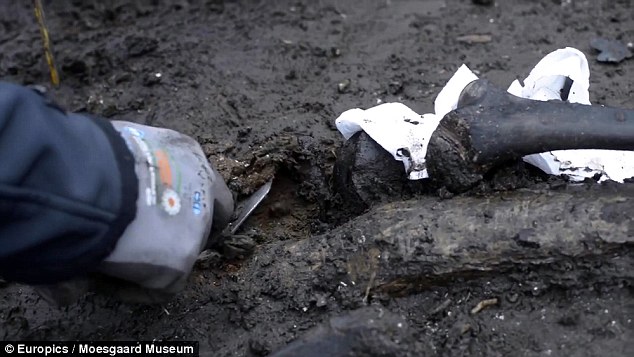
The human skeleton, found in a bog in a low-lying area below the remarkably preserved remains of an Iron Age village, is thought to have been in her twenties when she died.
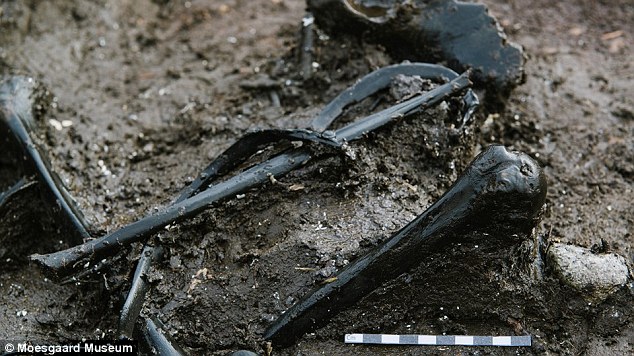
Her bones were found in a heap, indicating she had been thrown into the bog along with two stakes, one with a sharp point.
YOU MAY ALSO LIKE: Russian archaeologists discover 4,000-year-old city in southern Iraq
Archaeologists from Moesgaard Museum only recovered the jaw from the woman’s head, leading them to believe the skull had been separated from the body before it was ‘tossed’ into the bog.
The bog was originally used for peat cutting in the early Iron Age before seemingly taking on its chilling new role some centuries later.
Since the 1800s, a total of 13 dog skeletons next to tethering stakes, along with a wooden phallus and a trove of weapons including swords, lances and parts of a shield, have also been found in another bog just 492 feet (150 metres) away.
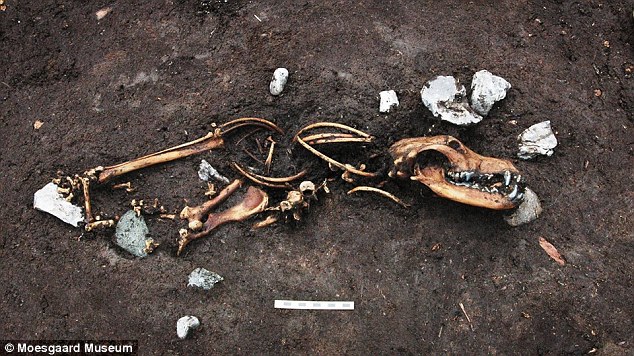
Little is known about the religion that the community practiced, but the archaeologists say that the bodies of humans and dogs were ‘clearly sacrificed’.
Moesgaard Museum director Per Mandrup hopes the ‘remarkable’ find will shed light on religious practices at the time.
He said: ‘We expected great things of the excavations because a settlement, a burial ground as well as extensive offerings and sacrifices in the bogs around Skødstrup have previously been found.
‘But these new discoveries more than live up to our expectations and the finding of a human skeleton is the crowning touch.’
The Danish find mirrors the discovery of the Lindow Man, whose remains were discovered by workers looking for peat in northwest England in 1984.
Like the young woman found in Denmark, he too had apparently been murdered, possibly as a ritual sacrifice carried out by Druids, having been hit twice in the top of the head with a blunt object.
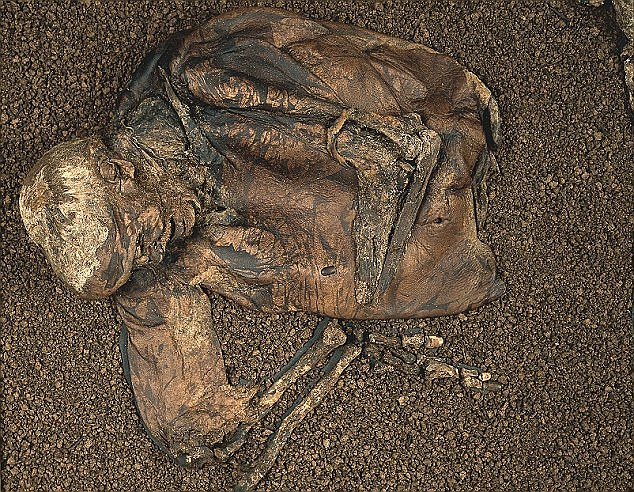
A cord was similarly tied around his neck before his throat was cut. His body was then thrown in the bog to complete the ritual.
The similarities between the two cases suggest the sacrifices may have been common practice and were widespread.
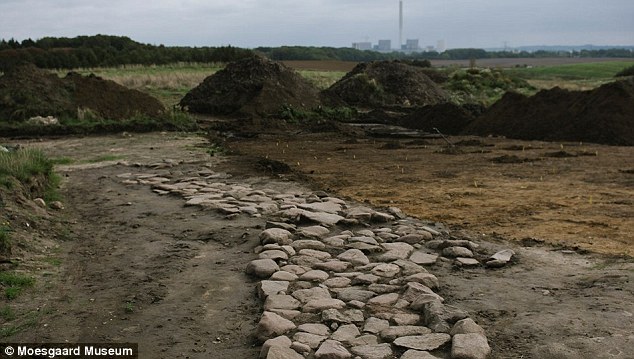
Experts hope more evidence of such sacrifices may be found in Denmark as they continue to excavate the site, which also includes the remains of a large village with a cobbled road and preserved house floors.
Mr Mandrup said: ‘At Skødstrup, we have the whole spectrum of an Iron Age community: A well-structured village with an associated burial ground and sacrificial bogs.
‘It gives us a unique insight into the life of Iron Age people in war and in peace and not least a glimpse into their religious universe.’
Religion and ritual appear to have been an important part of the lives of Iron Age people.
There have been a number of archaeological finds suggesting that sacrifices were common, although these were typically made by burying weapons and cauldrons in rivers, lakes and bogs because the water was seen as an important ‘doorway’ to the supernatural, according to The British Museum.
Many were made in the home, around the farm and in the countryside. Evidence of human sacrifices have been discovered, but these are much rarer.
The Romans wrote about the Druids, who were described as specialist priests, and they likely carried out many of these sacrifices.
YOU MAY ALSO LIKE: A 500-Year-Old Aztec Tower of Human Skulls Is Even More Terrifyingly Humongous Than Previously Thought, Archaeologists Find
It also appears that the gods and spirits of Iron Age religions didn’t have human forms because archaeologists have found few idols or statues from this time.
They similarly didn’t worship at shrines or temples, suggesting that their gods were omnipresent and could be celebrated in any location.
Published on [15 October 2015]


Urartian graves in eastern Turkey pointing out novel burial traditions
Rare Ancient DNA Provides Window Into a 5,000-Year-Old South Asian Civilization
Lost and found! 2,000-year-old leather shoe is discovered in Northern Germany after it disappeared into a bog
About Author
